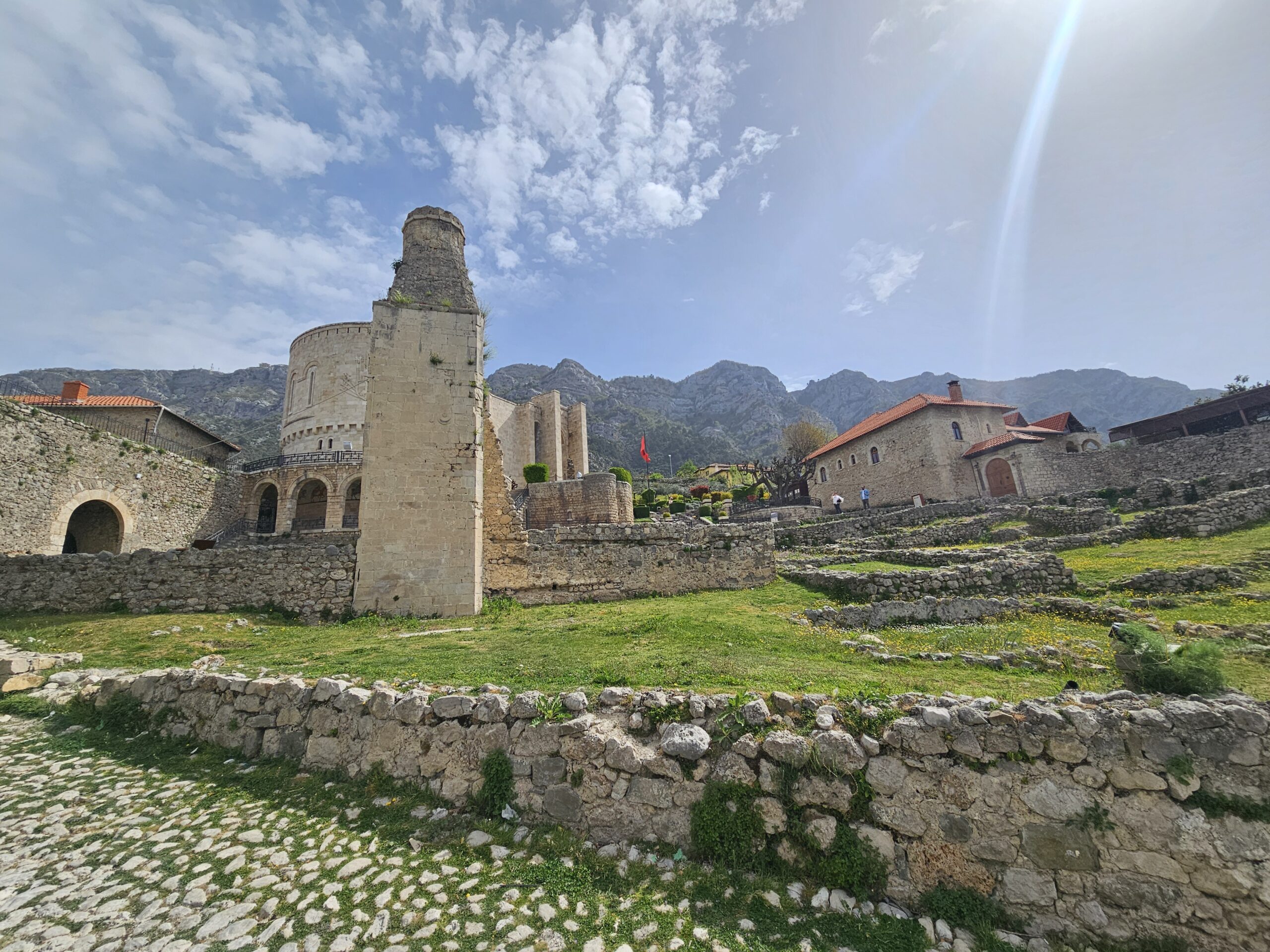
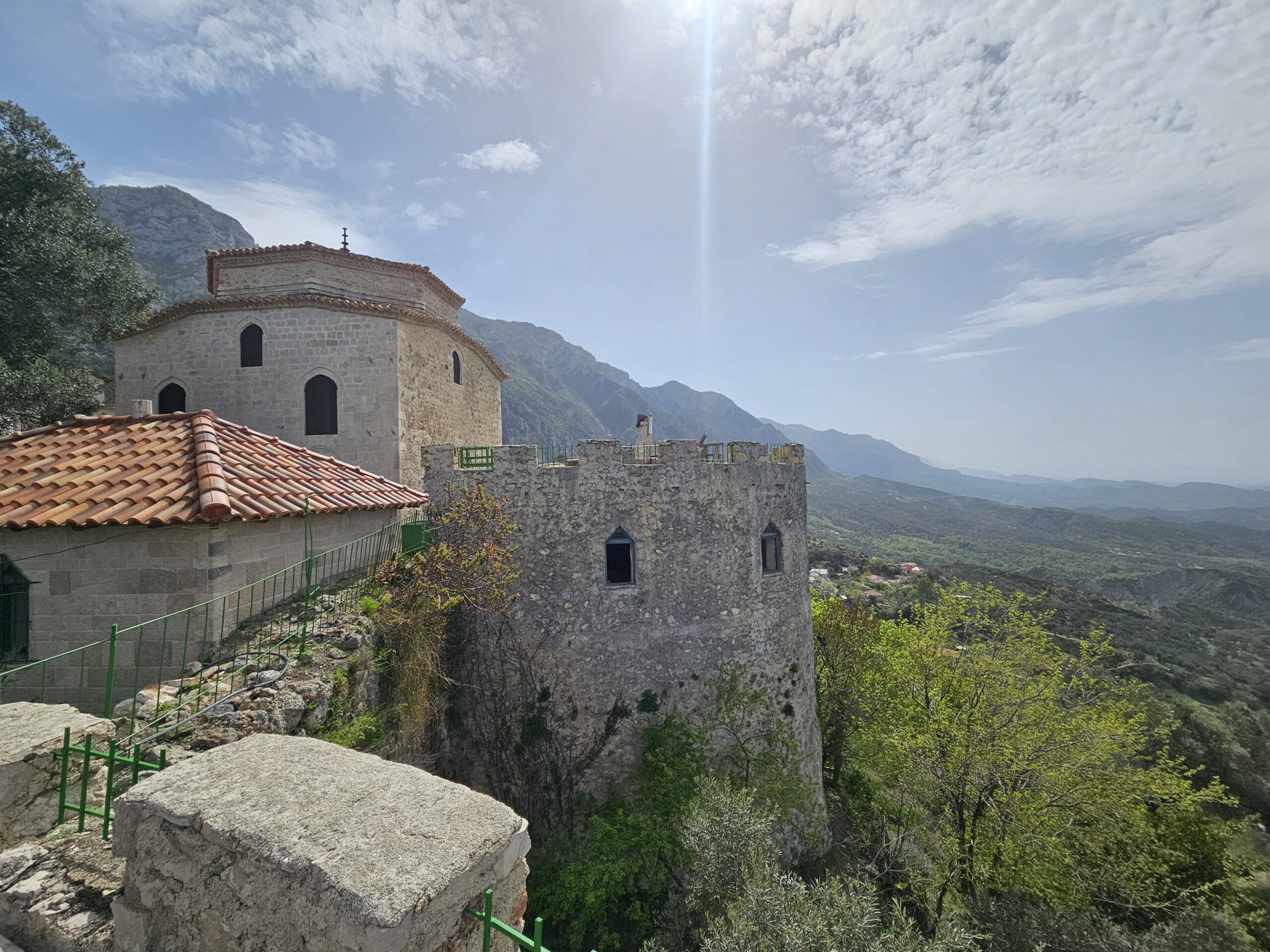
Half an hour north of Tirana, the road starts climbing and the city falls away behind you. To the right, a rock face rises sharply — a fortress on top, mountains behind it. That’s Kruja. And somehow, in that moment, you understand why Gjergj Kastrioti Skënderbeu chose exactly this place to organize his resistance against the Ottoman Empire.
The drive from Tirana takes 30–40 minutes by car or furgon — the small minibuses that are Albania’s real public transport backbone. From the Zogu i Zi bus station in Tirana, furgons leave regularly toward Kruja. Cheap, direct, no fuss. If you rent a car, there’s parking just below the fortress.


History You Can Touch
Kruja — or Krujë in Albanian — sits at about 600 meters on the slopes of the mountain that shares its name. The word kroi means water source in Albanian, which tells you something about why people settled here in the first place. The fortress walls go back to the 7th–8th centuries. By the 12th century, Kruja had become the center of the Principality of Arbëria, one of the earliest Albanian political structures.
Then came the Venetians. Then the Ottomans. What followed is the core of Albanian national identity: between 1443 and 1468, Skënderbeu defended this castle three times against Ottoman sieges — 1450, 1465, 1467. The country only fell under Ottoman control ten years after his death.
Five centuries of Ottoman rule shaped Kruja. But they didn’t erase it. That’s visible at every turn.
What to see and do
The Skanderbeg Museum
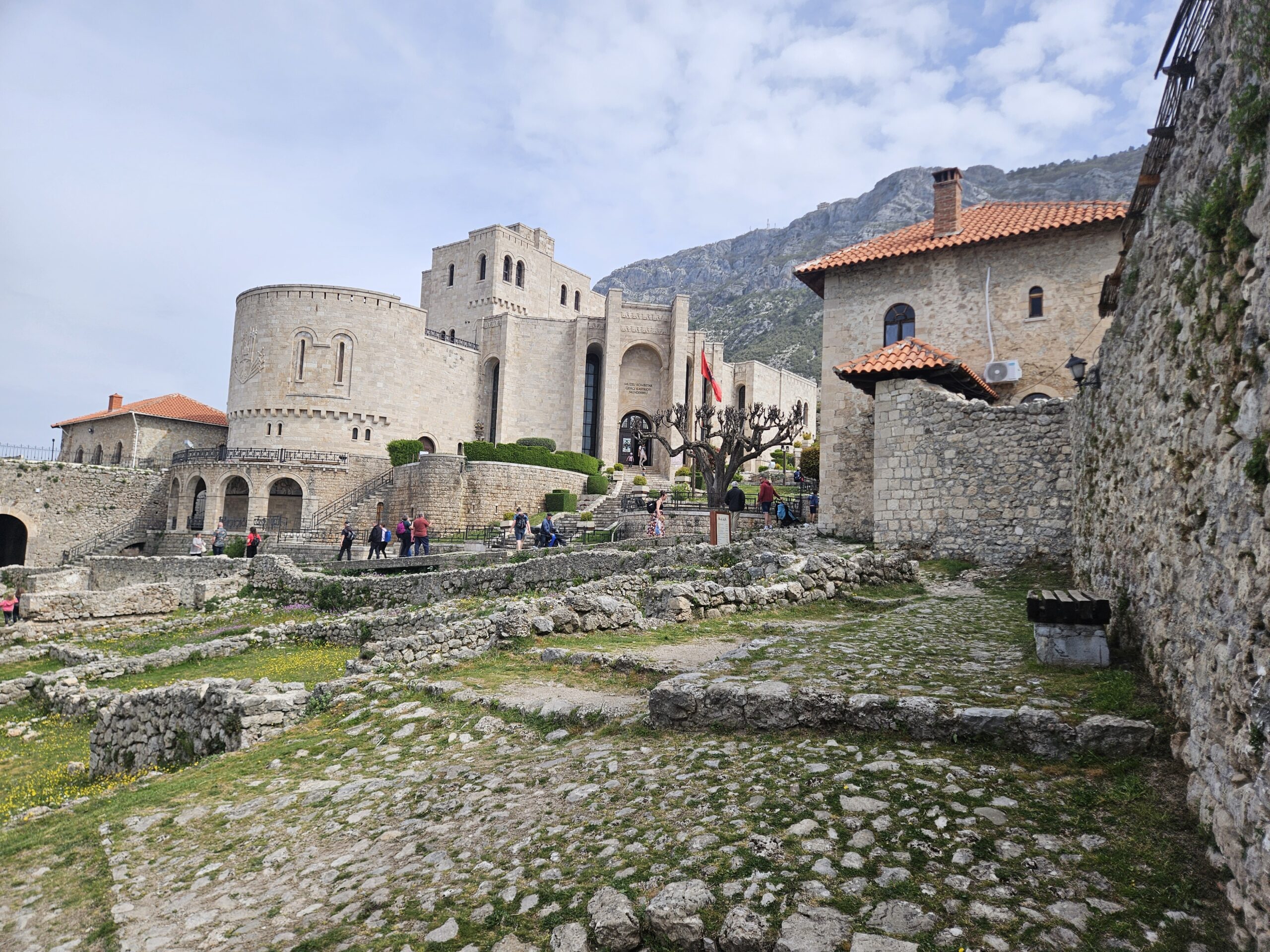
Built directly into the castle complex, the Skanderbeg Museum sits above the city like a statement. The building is a product of socialist Albania — inaugurated in 1982, designed by architects Pirro Vaso and Pranvera Hoxha, Enver Hoxha’s daughter. Stylistically it’s a strange hybrid of medieval fortress and communist-era monumental architecture. Somehow it works.
Inside, the exhibition covers Albanian history from the Arbëria period through the Ottoman centuries. The information panels across the castle grounds — co-funded by the Albanian-American Development Foundation, bilingual in English and Albanian — are genuinely well done. They explain each monument on the site: the Turkish Hammam built between 1478 and 1490, still largely intact; the ruins of the Old Mosque of Sultan Mehmet Fatih, damaged in 1831 and rebuilt in 1837–38.
I spent a long time up there. Not because of the exhibition, but because of the view. On a clear day you can see all the way toward the Adriatic coast. Olive trees, terracotta rooftops, mountain ranges layered into the distance. The thought that the last successful defense against the Ottoman Empire was coordinated from this exact spot is genuinely hard to process.
Also on the grounds: Skanderbeg’s Olive Tree — over 500 years old, supposedly planted on the national hero’s wedding day with Donika Kastrioti. Whether that’s history or legend doesn’t really matter. The tree is still there. It’s still growing.

The Ethnographic Museum
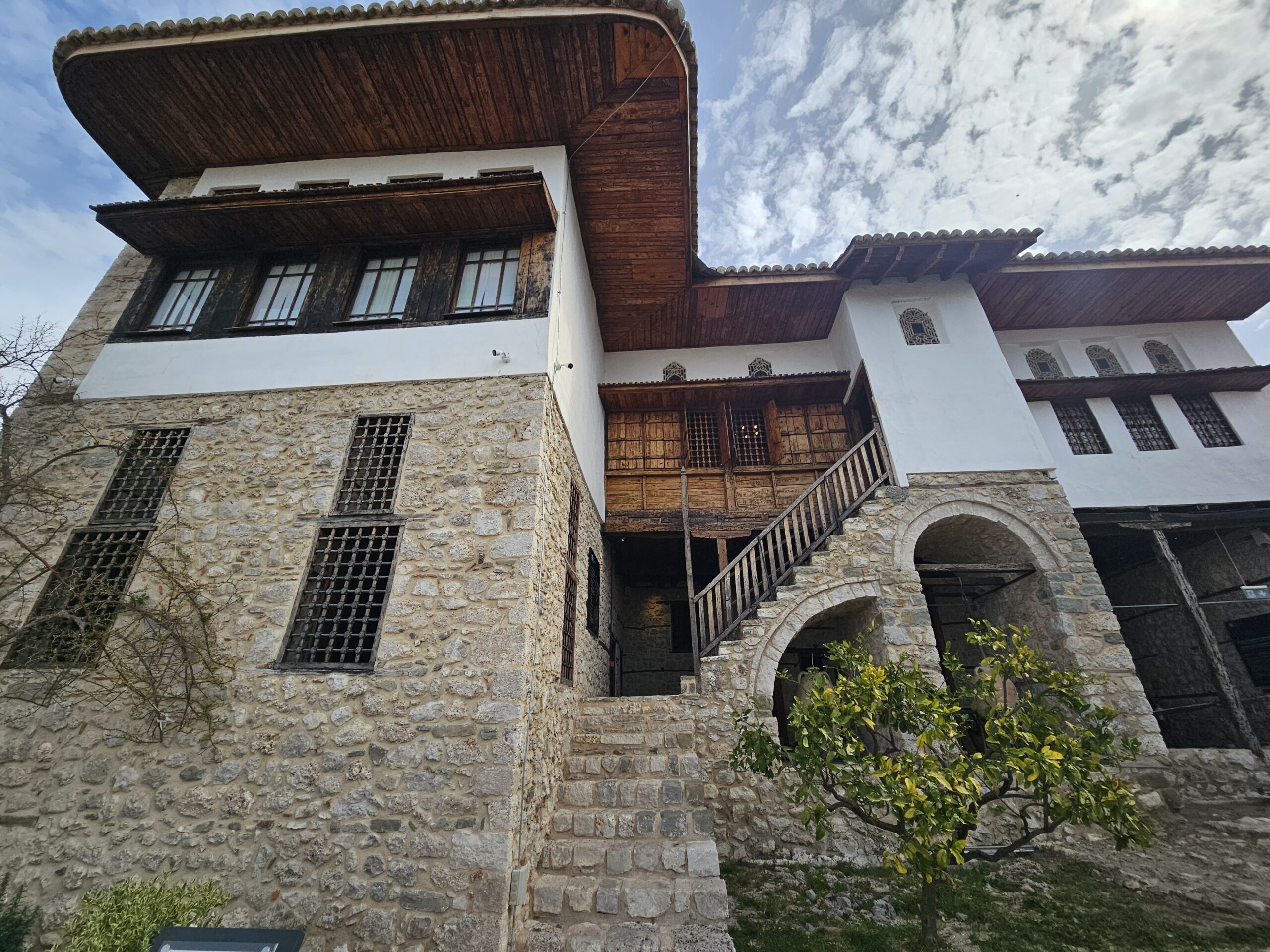
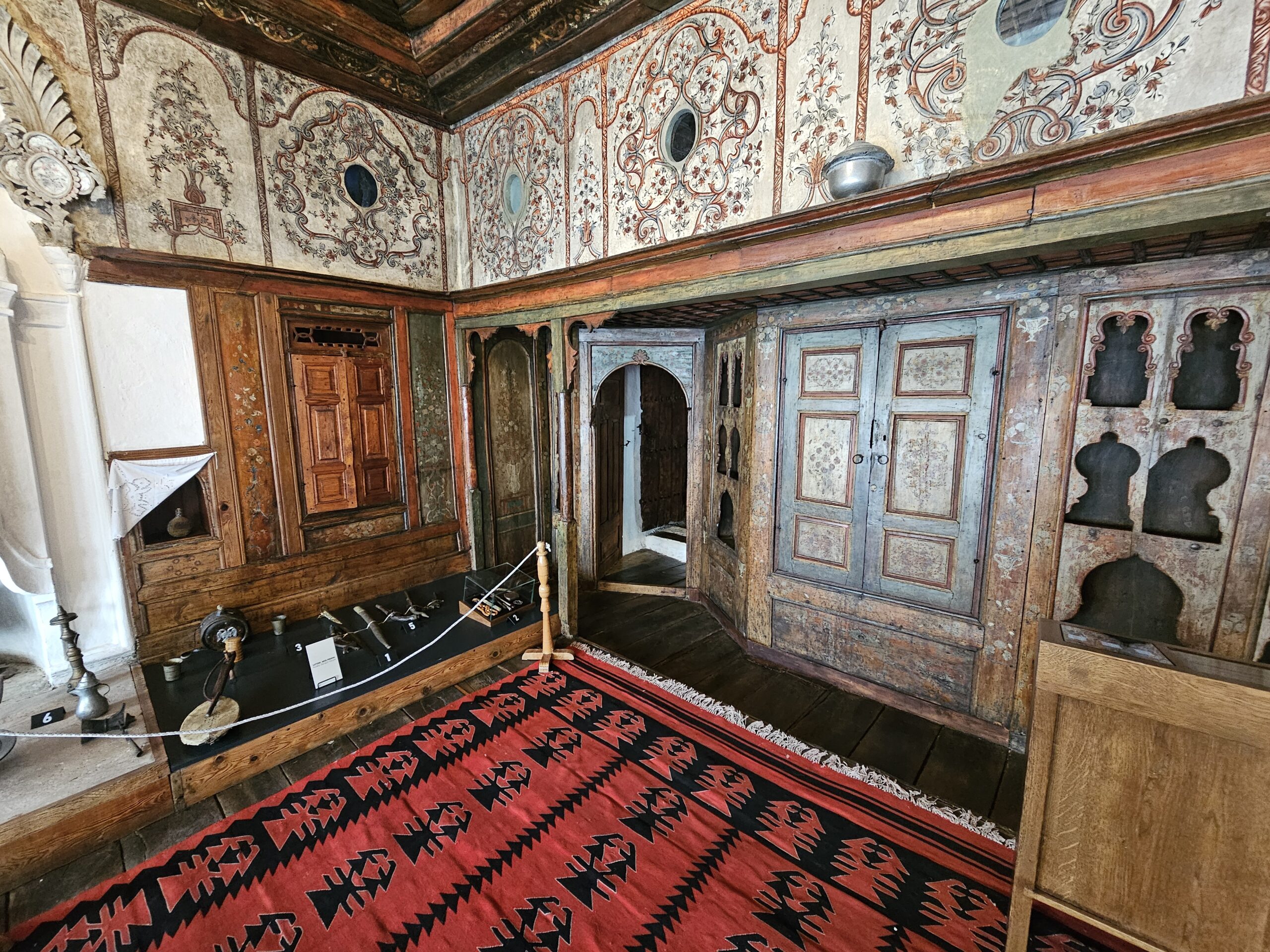
A short walk downhill from the Skanderbeg Museum, the Ethnographic Museum occupies the former residence of the Toptani family — an 18th-century house that shows Ottoman-era Albanian domestic architecture better than almost anything else still standing.
The original complex had two parts, Selamlık and Haremlik. Only the second survives today. Restored rooms inside show how a wealthy Albanian family of the 18th and 19th centuries actually lived.
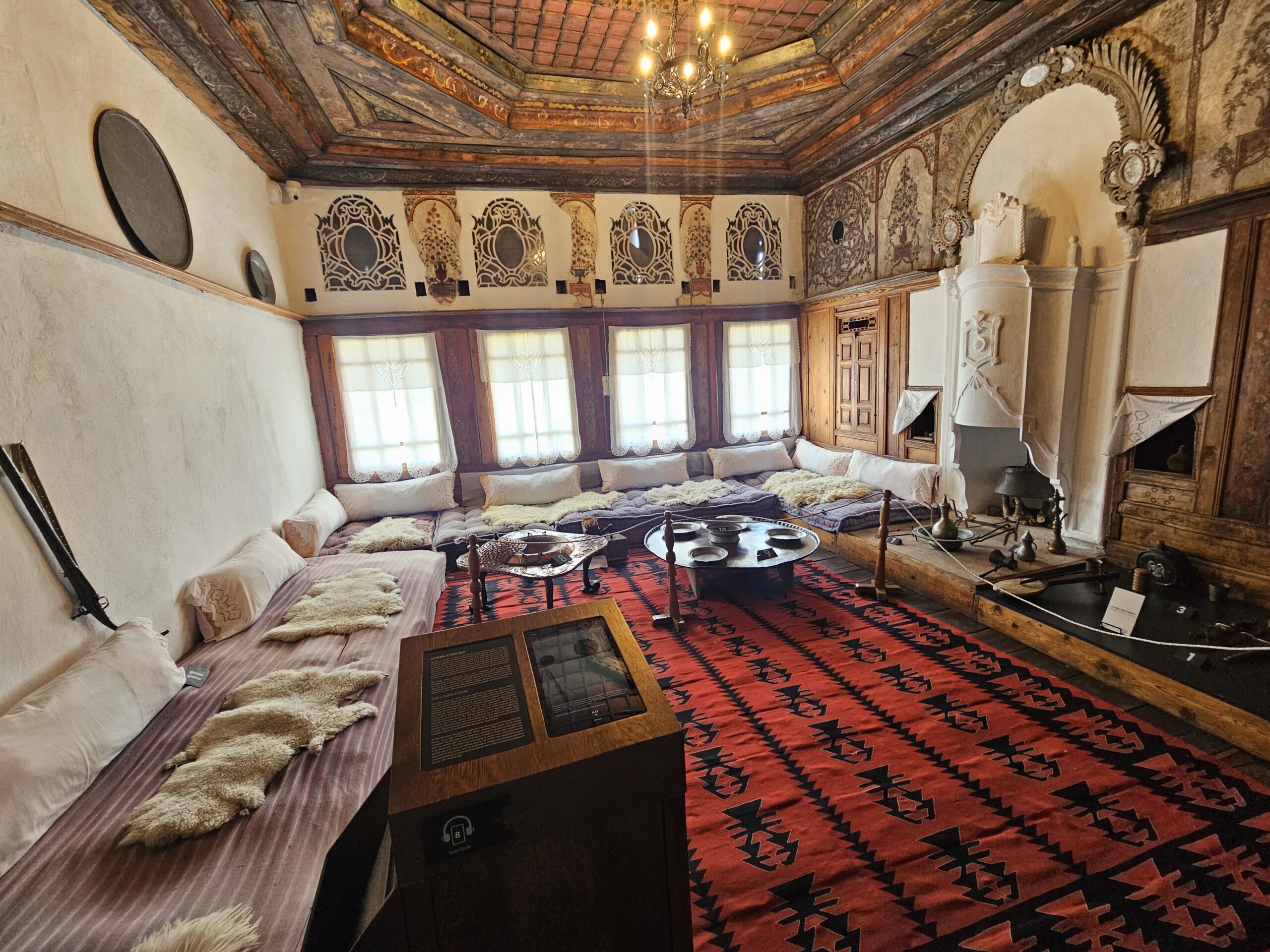
What stopped me longest: the Dhoma e Pritjes — the reception room. The museum sign explains that this room was treated almost as sacred. Never really used in daily life, always kept pristine, always ready for guests. Only men were allowed in. The host sat to the left of the fireplace, guests to the right. Anyone arriving handed over their weapon at the door — as a gesture of good faith.
That detail — weapon at the door, you are my guest — says more about Albanian hospitality than any guidebook passage.
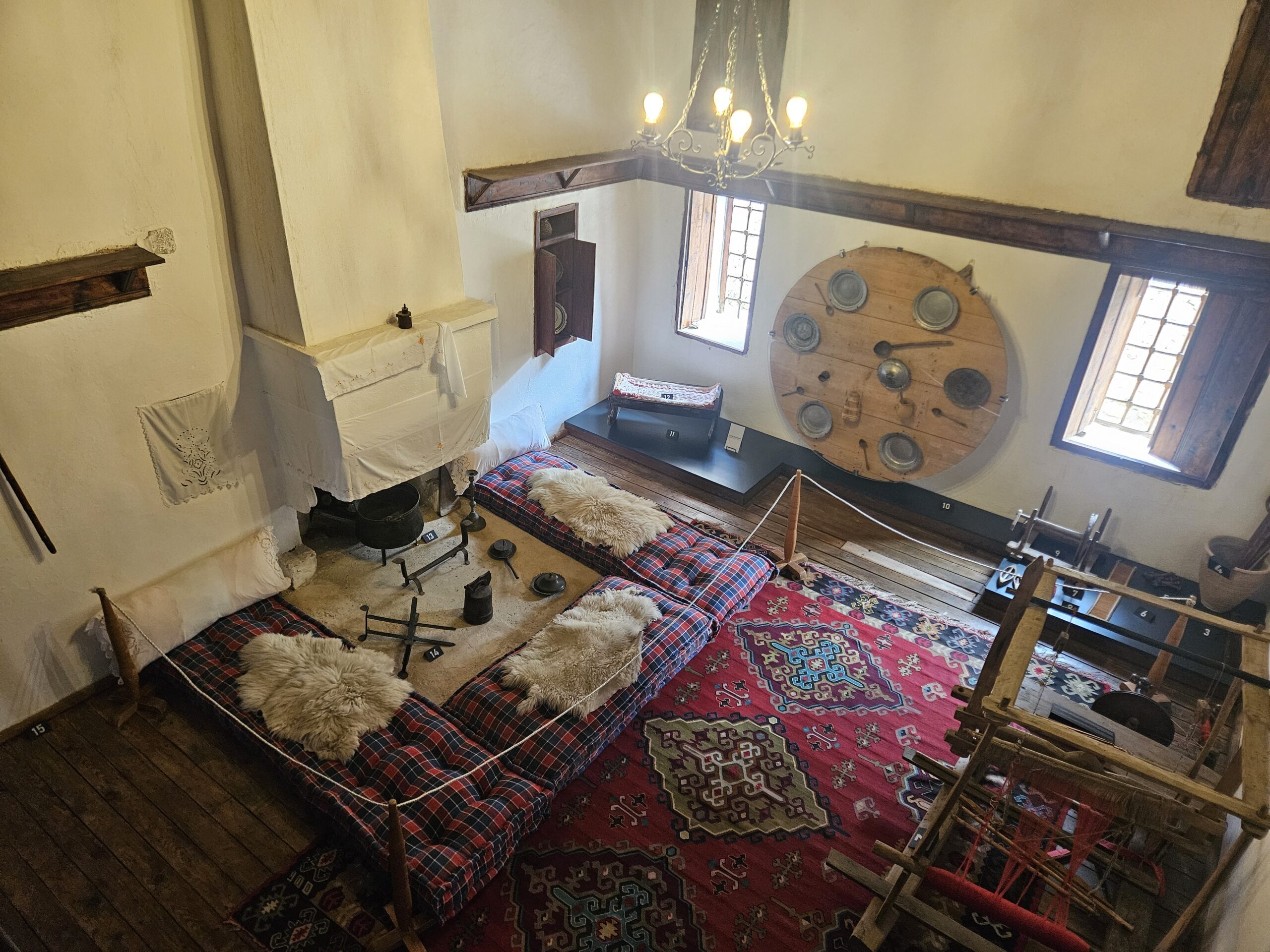
Next to it, the winter room. No gender divisions, no protocol, no hierarchy. The space where family was just family. Sheepskin on the sofas, a loom in the corner, women embroidering, children underfoot.
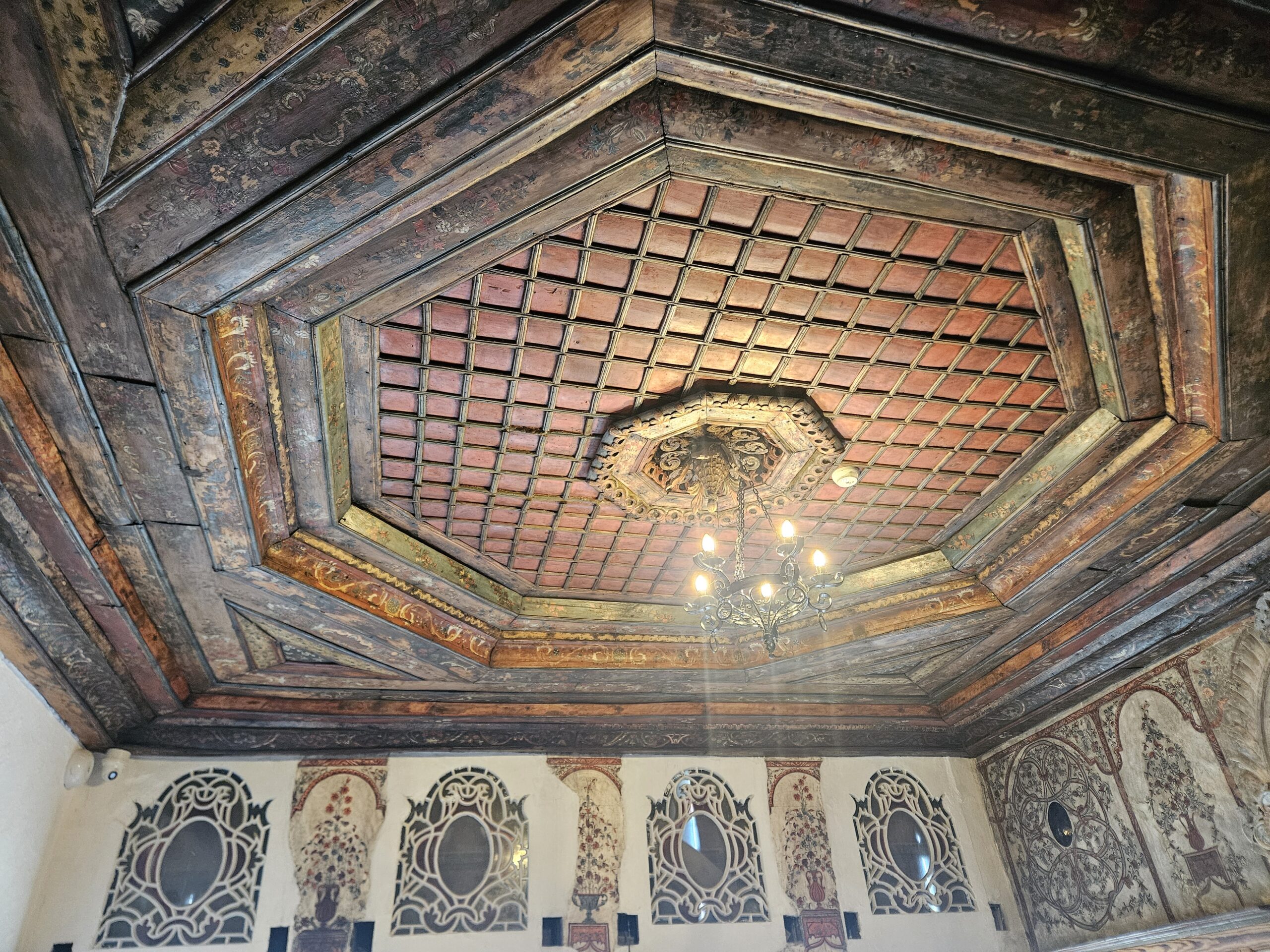
The painted ceilings in the reception room — ornamental motifs in oriental baroque style — are worth the entrance ticket on their own.
The Old Bazaar
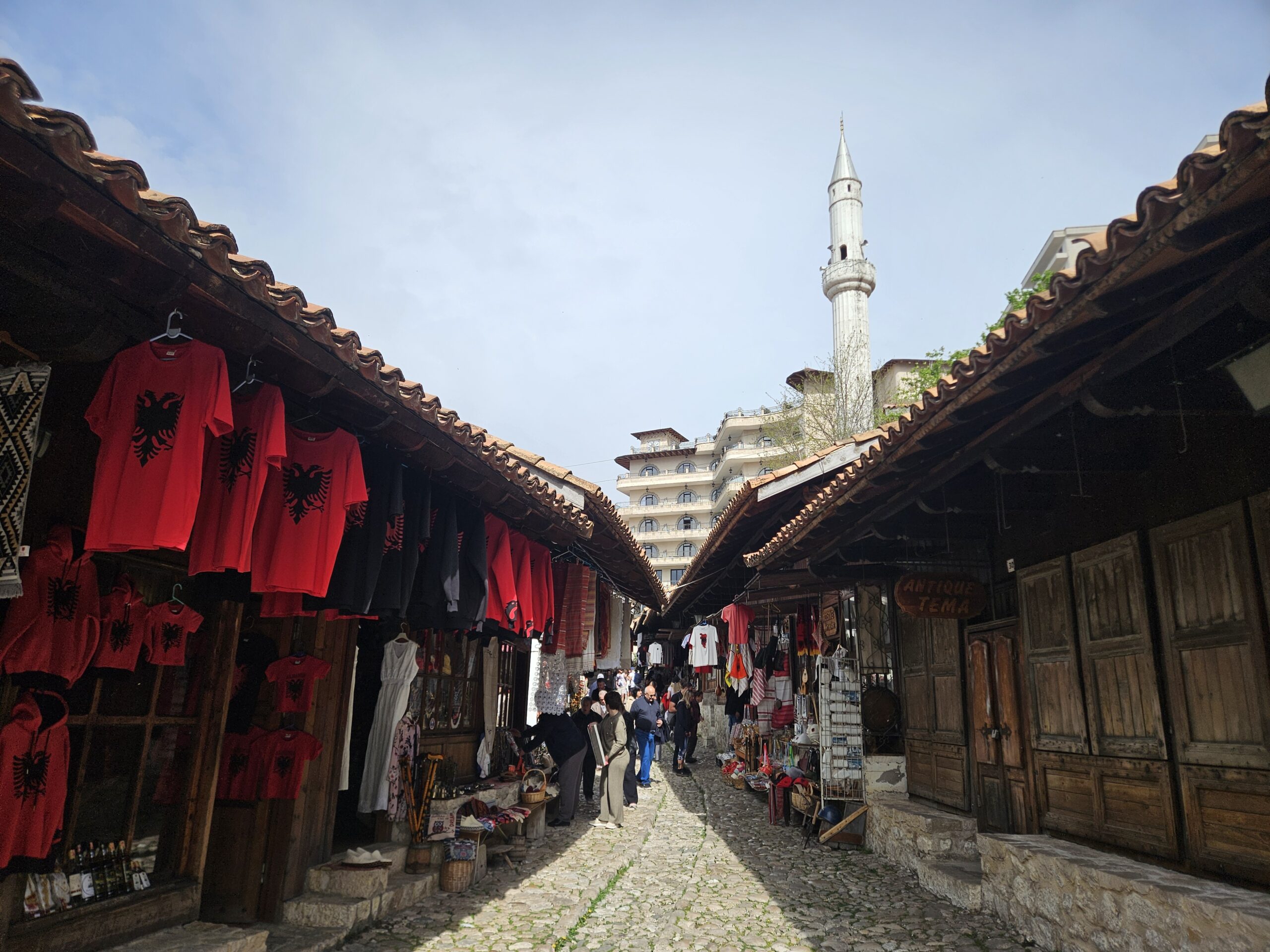
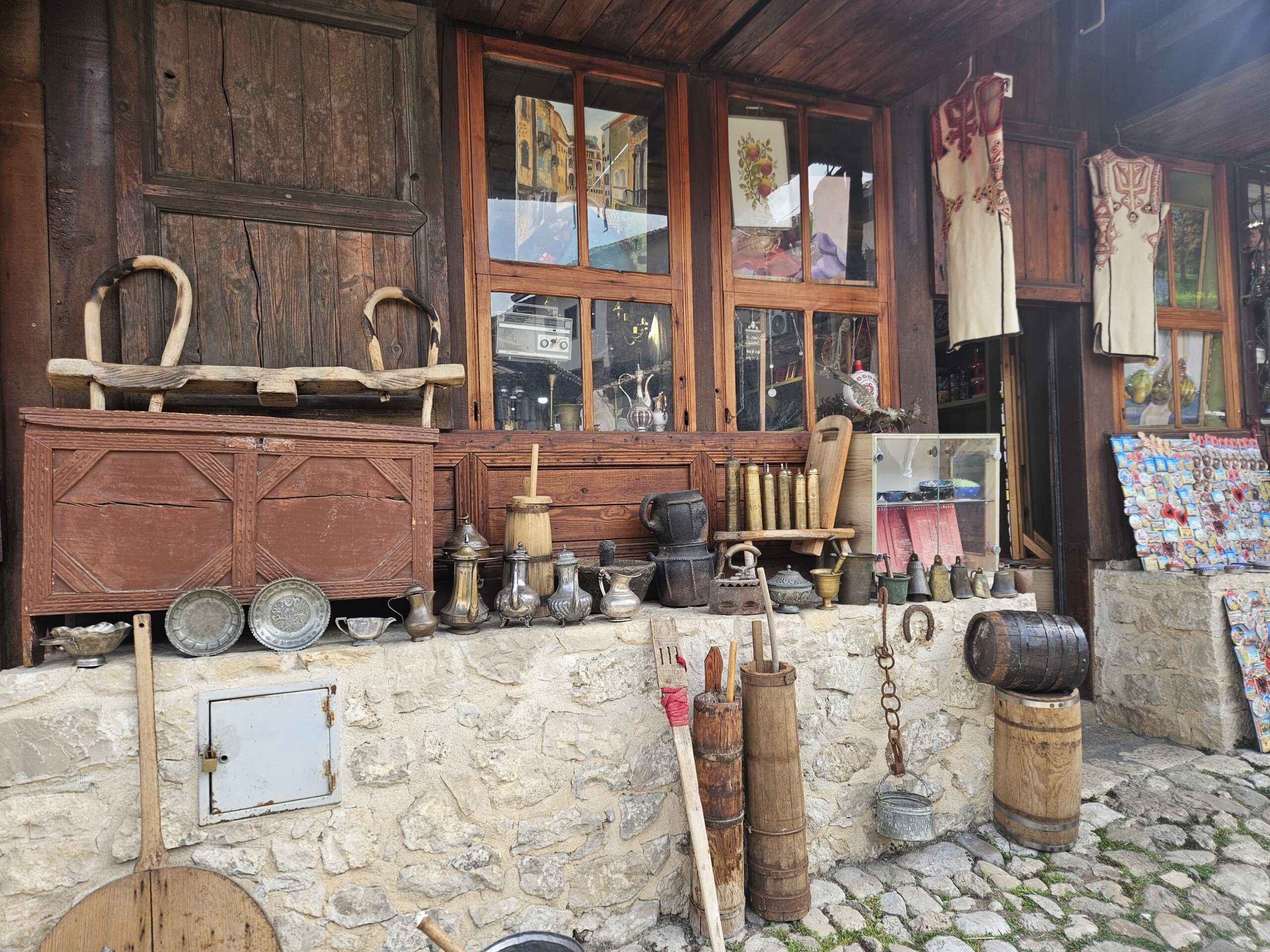
The Old Bazaar, Pazari i Vjetër, runs along the only road up to the castle. You pass through it whether you plan to or not. That’s intentional — it’s been this way since Skënderbeu’s time. The Ottomans expanded it, the 17th century gave it its economic peak, and since 1961 it’s been a protected cultural monument.
Today the shops sell mainly textiles, copperware, and handcrafted souvenirs — actual craftsmanship, not the usual tourist noise. Kelims, leather bags, woodwork. If you have time, you just walk and look.
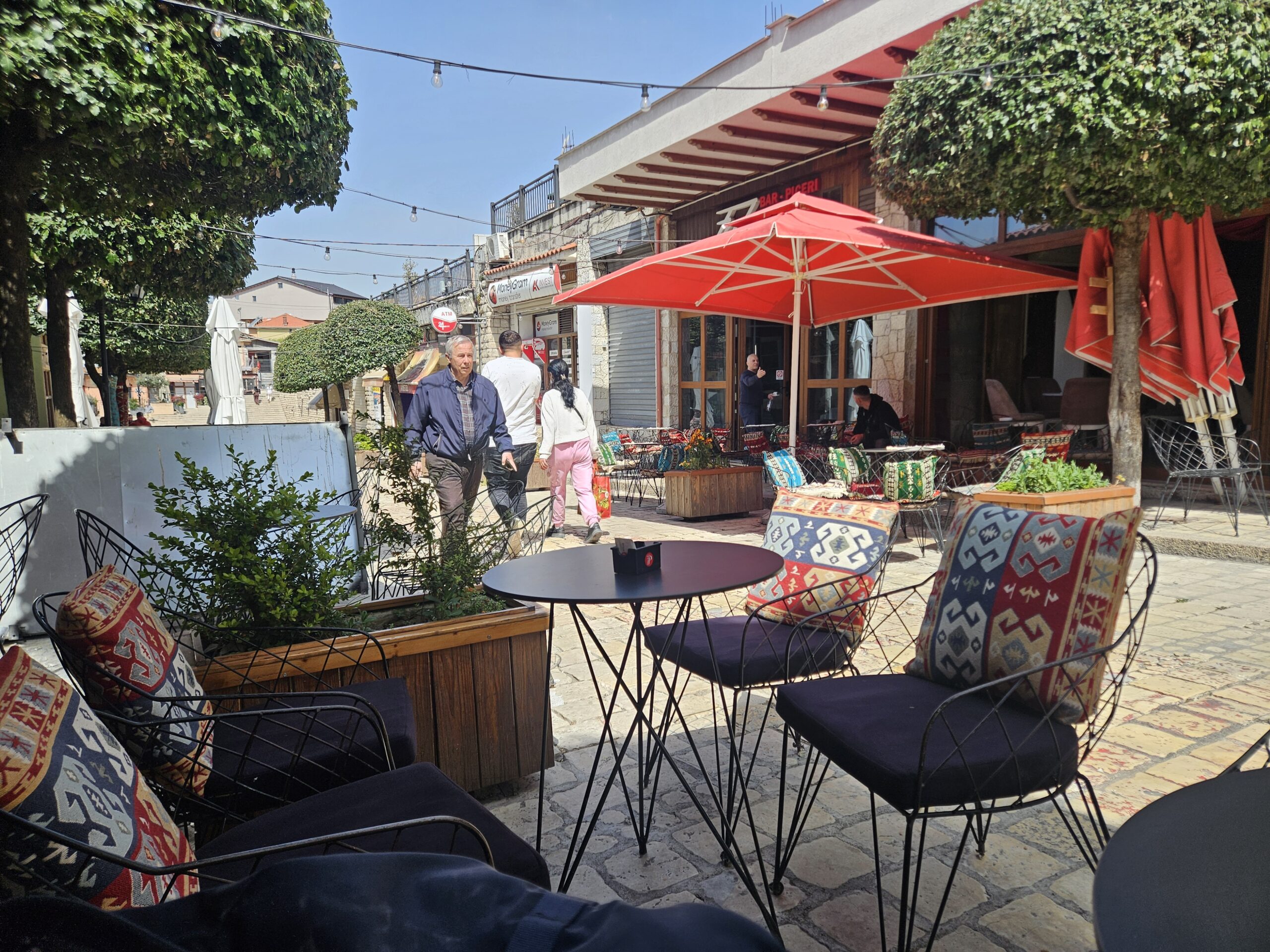
Lunch time: Where to eat
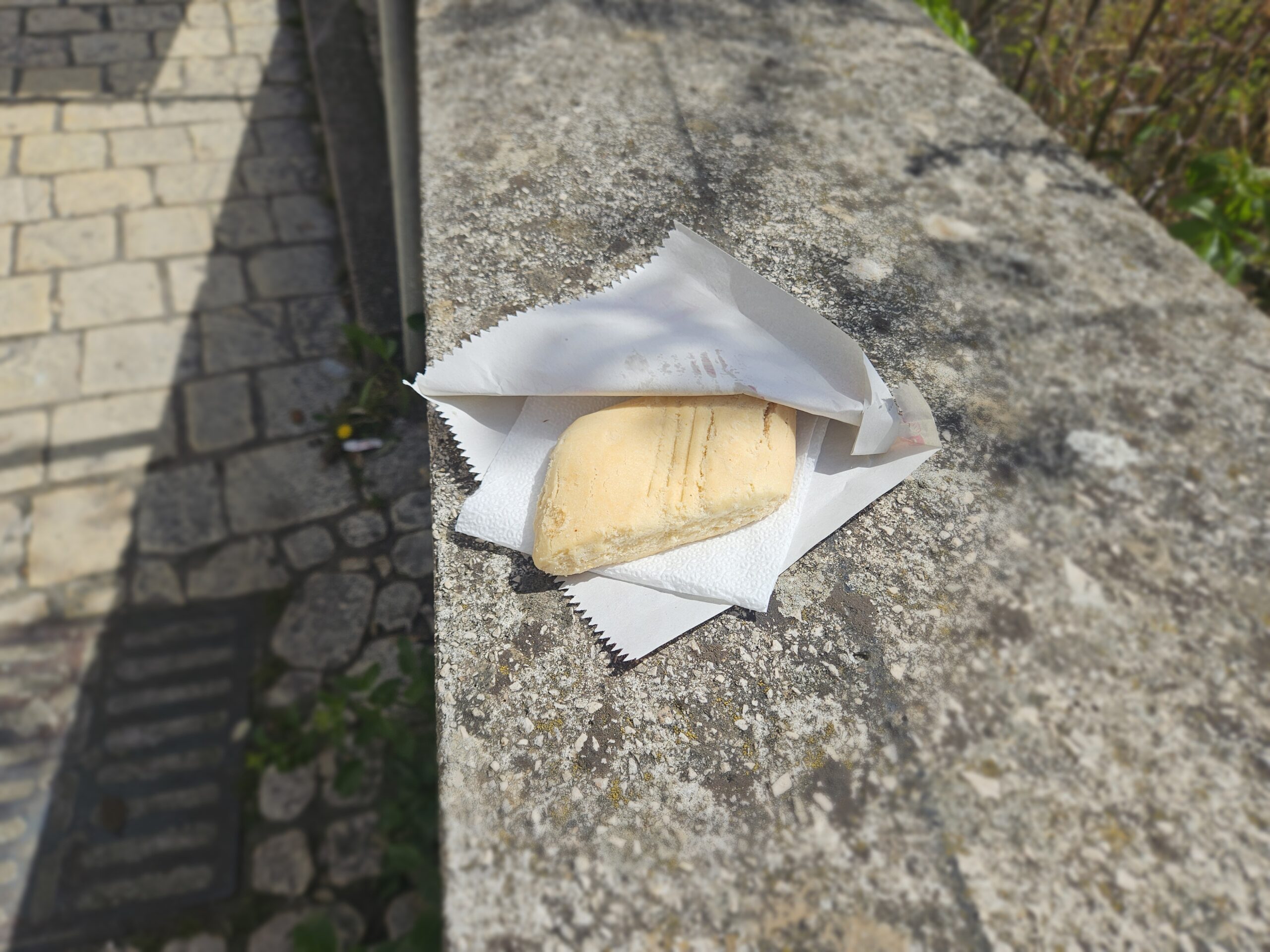
On the way up through the bazaar, small cafés and snack stands line the path. I picked up a traditional Albanian pastry from one of the stands — golden, flaky, slightly sweet, the kind of thing that costs about a euro and tastes exactly right eaten sitting on a stone wall with a view over the rooftops.
For a proper lunch, the cafés at the upper end of the bazaar near the castle entrance are the right call. Most have terraces looking out over the valley and serve Albanian home cooking: tave kosi (lamb baked in yoghurt), byrek (flaky pastry with cheese or spinach), qofte (grilled meatballs). Lunch for two with drinks runs about 10–15 euros.
What Kruja Actually Is
There are places you visit, and places you understand. Kruja belongs to the second category — but usually only on the drive home. While you’re there, you see stones, olive trees, a bazaar, a handful of other tourists. Then it starts to settle.
Someone here decided not to give in. Not once. Three times. And that decision made a difference that lasted not just militarily, but culturally, across generations. Albania carries Skënderbeu on its flag not as folklore but as a reminder of what’s possible when you actually commit.
That’s what Kruja sends you home with. You need half a day. And you leave differently than you arrived.

Practical information
- Skanderbeg Museum entry approx. 500 lek (€5)
- Ethnographic Museum approx. 600 lek (€6).
- Kruja makes a perfect day trip from Tirana, easily combined with an evening back in the city.
Ab 01. Juni 2026 ist Albanien Teil der Reisen von Individual Journey — kleine Gruppen, lokale Guides, echte Begegnungen. Wenn du informiert werden möchtest, sobald die Reisen buchbar sind, schreib mir gerne.